COCONUTS-2 b, discovered in 2021 using the NASA Infrared Telescope Facility (IRTF), holds the title for the planet with the longest orbital period around a single star. This distant giant orbits an M3 V-type star, approximately 10.8864 parsecs (about 35.5 light-years) from Earth. Let's explore the characteristics of this intriguing exoplanet and compare it to both Earth and Jupiter.
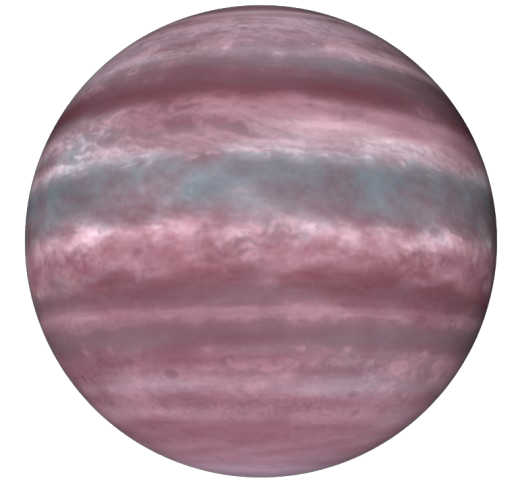
COCONUTS-2 b is a massive gas giant with a mass of 2002.3 Earth masses (6.3 Jupiter masses) and a radius of 12.44 Earth radii (1.11 Jupiter radii). It orbits its host star at a vast distance of 7506 AU, resulting in an orbital period of 402 million days. With an equilibrium temperature of 434 K (161°C), it is relatively cool due to its distance from its M3 V-type red dwarf star.
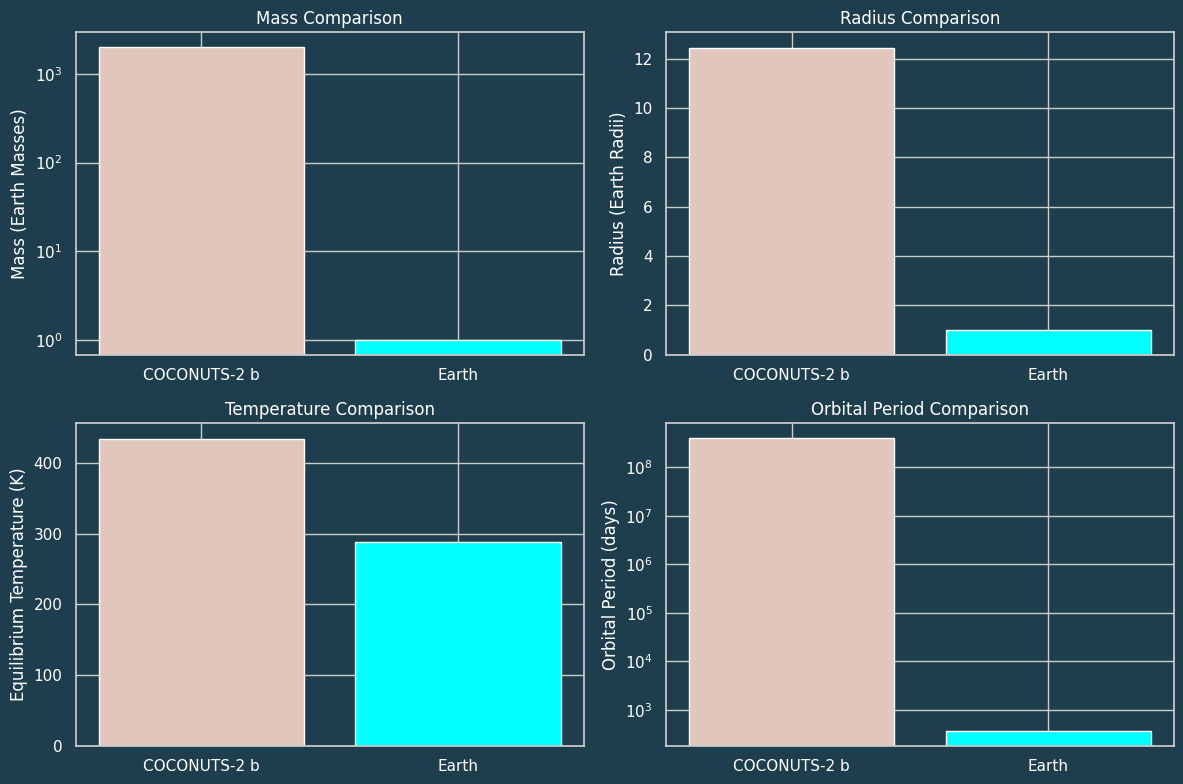
COCONUTS-2 b demonstrates extreme differences from Earth:
Mass and Size: Over 2000 times more massive and 12.44 times larger
in radius.
Orbital Characteristics: Orbits at 7506 AU compared to Earth’s 1
AU, with an orbital period of 402 million days versus Earth’s 365 days.
Temperature: Much colder at 434 K compared to Earth’s average of
288 K.
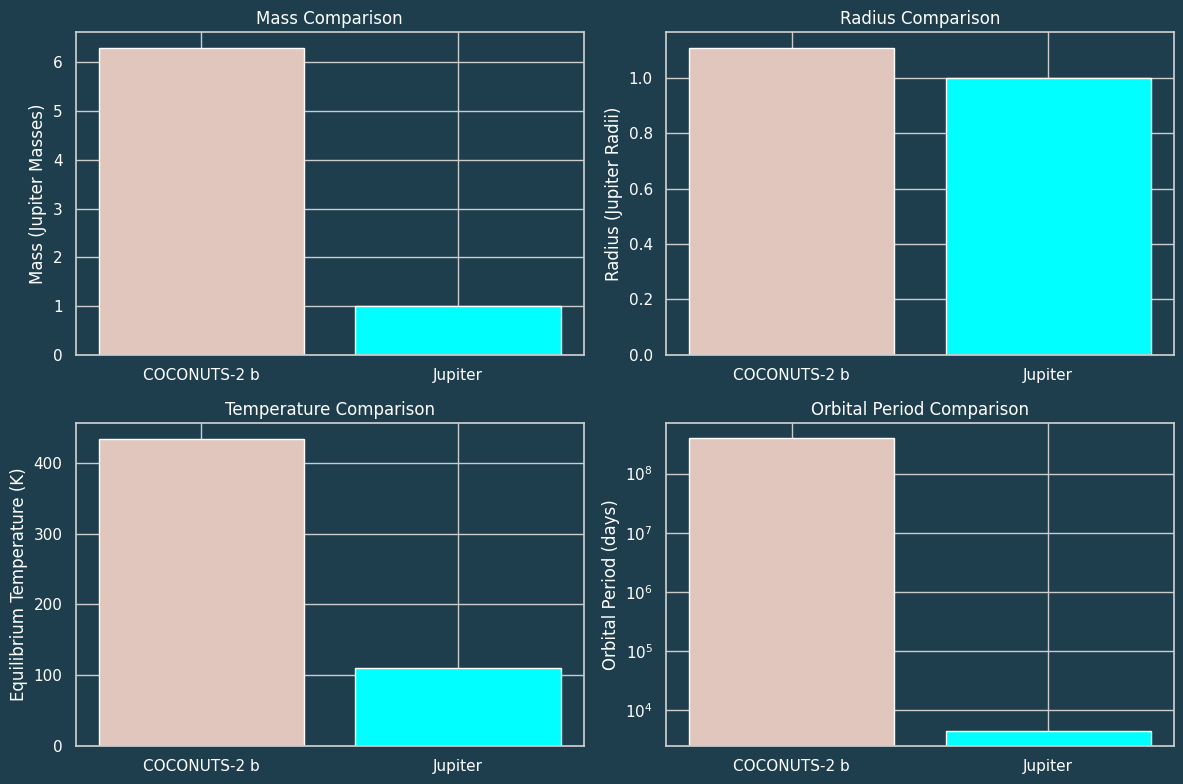
COCONUTS-2 b also differs notably from Jupiter:
Mass and Size: More massive at 6.3 Jupiter masses, with a slightly
larger radius of 1.11 Jupiter radii.
Orbital Characteristics:Orbits at 7506 AU with a vastly longer period compared to Jupiter’s 5.2 AU and 11.86 years.
Temperature: Higher equilibrium temperature of 434 K compared to
Jupiter’s 165 K.
Coconuts-2b is classified as non-habitable, with its large distance from its host star and gas giant composition making it unsuitable for life. Our machine learning model has determined that this exoplanet does not meet the necessary conditions for habitability.