55 Cancri e, discovered in 2004 by the McDonald Observatory, is a fascinating exoplanet orbiting
the G8 V-type star 55 Cancri A. This planet, located just 12.59 parsecs (approximately 41
light-years) from Earth, is classified as a "super-Earth" due to
its significantly higher mass
than Earth, but it resides in an orbit that subjects it to incredibly extreme temperatures.
Let’s explore its unique features and compare it to both Earth and Jupiter.
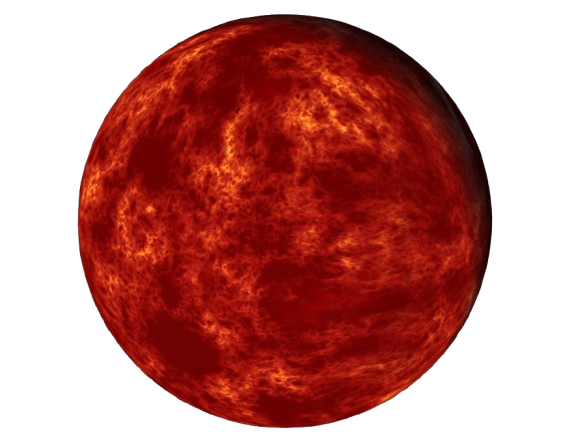
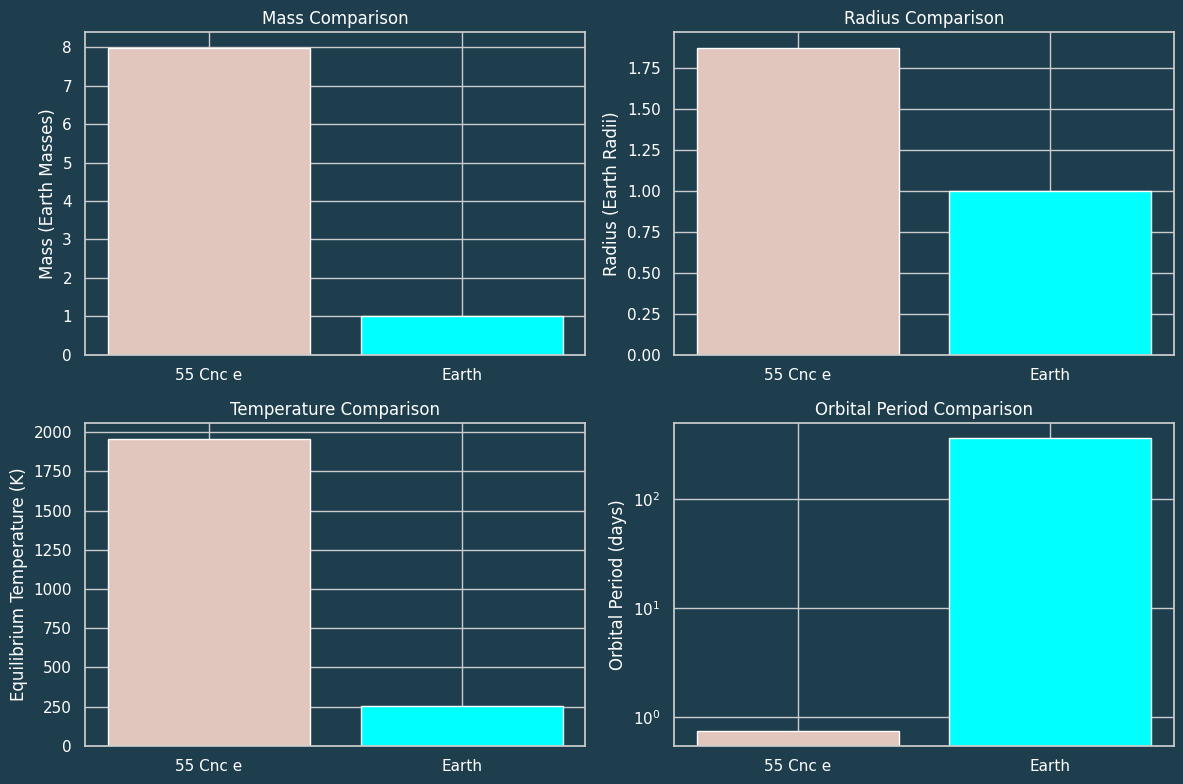
55 Cancri e is a super-Earth with a mass of 7.99 Earth masses and a radius of 1.875 Earth radii, making it almost twice the size of Earth but much denser.
Due to its extreme proximity to its host star, 55 Cancri e experiences an incredibly high equilibrium temperature of 1958 K (1685°C).
It orbits exceptionally close to its host star at a distance of only 0.01544 AU, about 25 times closer than Mercury is to the Sun. This tight orbit results in an orbital period of just 0.736 days, meaning a year on 55 Cancri e lasts less than 18 hours.
The host star is a G8 V-type star, similar to our Sun but slightly cooler. The system has a metallicity ratio [Fe/H] of 0.35, indicating a higher concentration of heavy elements than in our Solar System.
55 Cancri e stands out for its extreme characteristics compared to Earth:
Mass and Size: With a mass of 7.99 Earth masses and a radius of
1.875 Earth radii, it is nearly twice as large and eight times heavier than Earth.
Orbital Characteristics: It orbits extremely close to its host star
at 0.01544 AU, resulting in an orbital period of less than 1 day, compared to Earth’s 365 days.
Temperature:The surface temperature is 1958 K (1685°C), much higher
than Earth’s average of 288 K (15°C).
Habitability: The extreme heat likely makes it uninhabitable by
Earth-like standards.
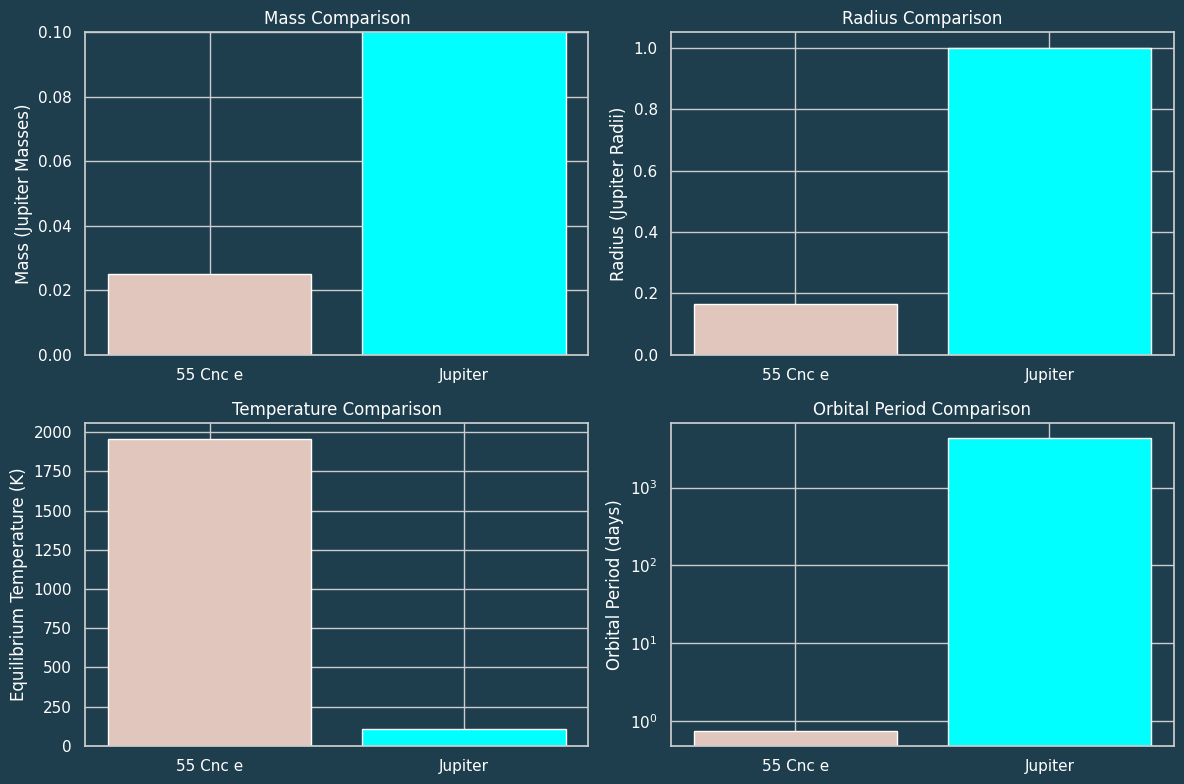
Though both 55 Cancri e and Jupiter are much more massive than Earth, they differ significantly:
Nature: 55 Cancri e is a rocky
super-Earth, while Jupiter is a
gas giant.
Mass and Size: Jupiter has 318 Earth masses, dwarfing 55 Cancri e’s
7.99 Earth masses. However, 55 Cancri e is much smaller in physical size with a radius of 0.167
Jupiter radii.
Orbital Characteristics: Jupiter orbits the Sun at 5.2 AU, taking
nearly 12 years to complete one orbit, while 55 Cancri e orbits its star at 0.01544 AU,
completing an orbit in less than a day.
Temperature: Jupiter’s equilibrium temperature is 165 K, far cooler
than 55 Cancri e’s 1958 K due to its proximity to its star.
55 Cancri e is a fascinating super-Earth with extreme conditions far different from anything in our Solar System. Its size and mass place it between Earth and gas giants like Jupiter, but its extreme heat, rapid orbit, and close proximity to its star make it a unique and hostile world. The contrast between 55 Cancri e and both Earth and Jupiter highlights the diversity of exoplanets and the variety of planetary systems in the universe.